Complete Intake Details
Complaint records should include complaint source, date received, reporter information, product identifiers, event description, region, and available supporting details.

Audit-ready complaint documentation means complaint records are structured, traceable, complete, organized, and prepared for authorized review. It does not mean outsourced support replaces manufacturer responsibility.
For medical device complaint teams, documentation quality affects intake, triage, investigation, MDR/vigilance workflow support, PMS inputs, CAPA linkage, complaint trending, and final QA/RA review readiness.
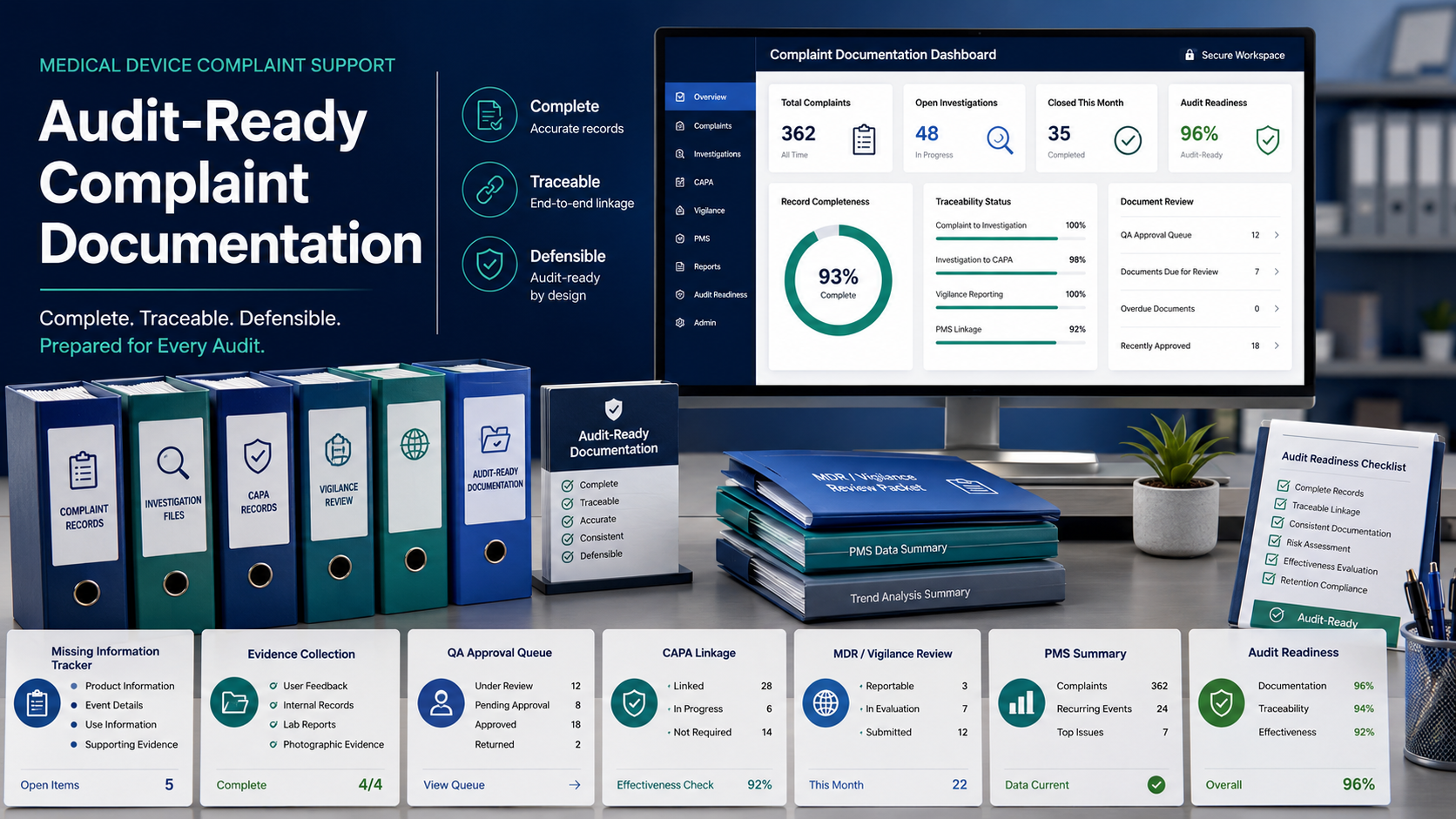
Medical device complaint records can move through multiple teams before closure. Intake teams may capture the first information. Complaint handling units may create and update the case. QA and RA teams may review escalation needs. Investigation teams may add evidence. PMS and CAPA teams may use complaint data for trend review and quality follow-up.
Because many teams may rely on the same complaint record, documentation must be clear, organized, and traceable. A reviewer should be able to understand what happened, what product was involved, what evidence exists, what information is missing, what follow-up occurred, and which decisions remain open.
Medical Device Complaint Support provides operational, documentation, workflow, and back-office support to help complaint teams prepare cleaner records and review-ready documentation packets under client-approved procedures.
Complaint records should include complaint source, date received, reporter information, product identifiers, event description, region, and available supporting details.
The event description should be understandable, structured, and specific enough for authorized reviewers to assess the complaint without searching through scattered notes.
Follow-up attempts, reporter responses, internal notes, pending questions, and communication logs should be documented in a consistent and review-friendly format.
Images, service records, returned product notes, investigation evidence, and technical documents should be indexed and linked clearly to the complaint record.
Open fields, incomplete product details, pending attachments, unclear event information, and follow-up needs should be visible instead of hidden in notes.
Documentation should make clear which items are support-prepared and which decisions remain with manufacturer QA, RA, PMS, CAPA, or authorized personnel.
Traceability is one of the most important qualities of complaint documentation. A complaint file should show how the record was created, what information was available, what follow-up occurred, what evidence was attached, what was still missing, and where the case moved next.
Traceability helps internal teams avoid confusion during review. It also supports stronger handoffs between complaint intake, triage preparation, investigation documentation, MDR/vigilance workflow support, PMS summaries, CAPA coordination, and final manufacturer review.
When documentation is not traceable, teams may spend time reconstructing the case from emails, spreadsheets, CRM notes, service logs, and attachments. That creates unnecessary delays and weakens review readiness.
Important boundary: audit-ready documentation support can help organize records, evidence, trackers, and summaries. Final regulatory decisions, quality decisions, audit responses, MDR submissions, CAPA decisions, and complaint closure decisions remain with the manufacturer or authorized personnel.
Complaint received
Case created
Required fields checked
Missing information tracked
Evidence organized
Investigation support prepared
PMS/CAPA/MDR visibility maintained
Authorized QA/RA review
The exact documentation requirements depend on the manufacturer’s approved procedures, complaint system, device type, market, risk profile, and quality process. However, many complaint files benefit from a consistent documentation structure.
When these elements are organized clearly, complaint records become easier for internal teams to review and maintain under approved procedures.
Complaint documentation becomes weak when essential details are missing or difficult to locate. Even if the complaint was handled operationally, a poorly organized record may make later review slower and more complicated.
Common gaps include vague event descriptions, missing device identifiers, no clear complaint source, incomplete dates, poor attachment indexing, weak communication history, missing follow-up status, inconsistent issue categories, and unclear investigation references.
Incomplete intake fields, unstructured notes, duplicate records, missing evidence, no clear owner for follow-up, weak escalation visibility, and no organized summary for QA/RA review.
Structured documentation support helps reduce these issues by preparing cleaner records, stronger trackers, better evidence organization, and more consistent review packets.
Medical Device Complaint Support can assist with complaint documentation under client-approved procedures, templates, systems, and access controls. Support can be used for active complaint queues, backlog cleanup, investigation file organization, MDR/vigilance packet preparation, PMS data support, CAPA linkage, and trend summaries.
The objective is to help regulated teams work from cleaner, more organized, and more review-ready complaint files.
Complaint records may include product identifiers, customer details, reporter information, event narratives, clinical context, returned product evidence, investigation findings, service notes, and quality-system information.
Public website inquiries should remain process-focused. Detailed complaint records, patient-identifiable information, protected health information, proprietary product information, reportable event records, or confidential quality-system data should only be exchanged through secure client-approved communication channels after engagement review.
Medical Device Complaint Support provides operational, documentation, workflow, and back-office support only. This article does not provide legal, regulatory, clinical, or quality-system consulting advice.
It means complaint records are structured, complete, traceable, organized, and prepared for authorized review. It does not mean outsourced support makes final regulatory, quality, or audit response decisions.
Yes. Documentation support can help organize older complaint records, identify missing information, index attachments, update trackers, prepare summaries, and make files more review-ready under client-approved workflows.
Yes. Cleaner complaint records can support MDR/vigilance review packet preparation, PMS inputs, CAPA linkage, related complaint grouping, trend summaries, and authorized quality review workflows.
No. We provide operational documentation and workflow support. Final audit responses, regulatory explanations, quality decisions, MDR submissions, CAPA decisions, and complaint closure decisions remain with the manufacturer or authorized personnel.
Contact Medical Device Complaint Support for complaint file organization, missing information tracking, evidence indexing, investigation documentation, and review-ready workflow support.
Medical Device Complaint Support provides operational, documentation, workflow, and back-office support for complaint handling processes. Final regulatory decisions, audit responses, MDR submissions, reportability determinations, legal interpretations, quality approvals, PMS conclusions, CAPA decisions, product risk decisions, and final complaint closure decisions remain the responsibility of the medical device manufacturer or authorized QA/RA personnel.
This article is for general informational purposes only and does not provide legal, regulatory, clinical, or quality-system consulting advice.