1. Capture the Complaint Source
Document where the complaint came from, such as customer email, distributor report, call center note, service record, field report, CRM case, or regional support channel.
Complaint intake is the first control point in the medical device complaint handling workflow. If the intake record is incomplete, unclear, or inconsistent, every downstream activity becomes harder.
Strong intake practices help complaint teams create cleaner records, track missing information, prepare triage-ready cases, support investigation documentation, and improve visibility for QA, RA, PMS, CAPA, and complaint operations teams.
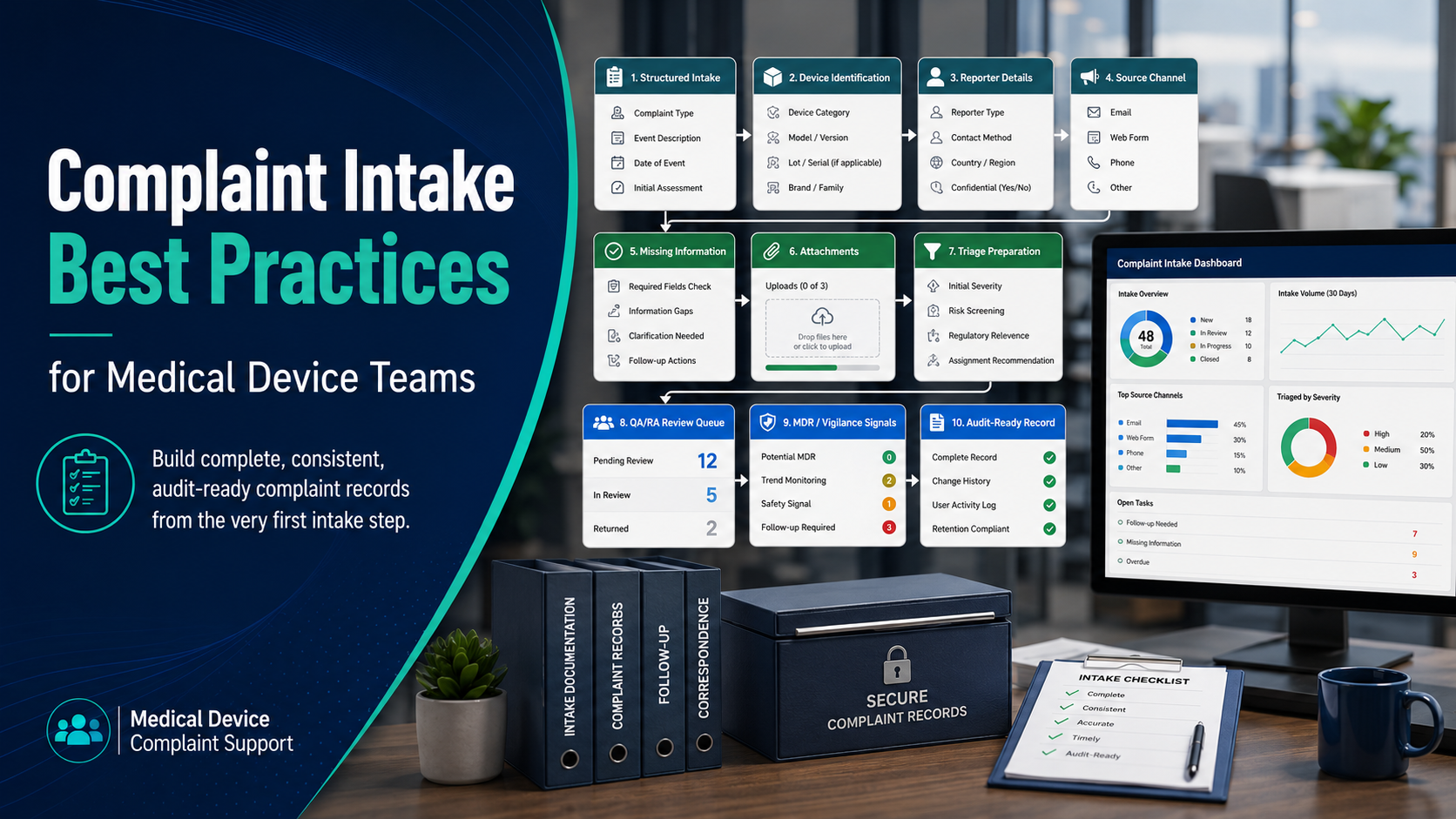
A medical device complaint can arrive through many channels: customer service, email, distributor reports, hospital users, field service teams, technical support, regional teams, CRM tools, service logs, or complaint systems. Intake is the step where those signals are converted into structured complaint records.
The intake record should capture enough information for authorized reviewers to understand the complaint, identify the product, assess open information gaps, route the case, and decide whether further review or investigation is required.
When intake is weak, teams may face missing device identifiers, unclear event descriptions, incomplete reporter details, poor attachment tracking, duplicate case creation, and delayed escalation. Strong intake reduces these problems and creates a cleaner foundation for the full complaint handling lifecycle.
Document where the complaint came from, such as customer email, distributor report, call center note, service record, field report, CRM case, or regional support channel.
Capture the reporter name, organization, contact details, role, region, and preferred follow-up channel according to client-approved procedures and privacy controls.
Collect available product name, model, catalog number, lot number, serial number, UDI, software version, accessory details, or other device identifiers where applicable.
Document what happened in simple, structured language. Avoid vague notes that make triage, investigation, and escalation difficult.
Create visibility into open fields, missing attachments, unclear dates, incomplete device details, pending follow-ups, and information needed for authorized review.
Organize intake details so QA, RA, complaint handling, PMS, or CAPA reviewers can quickly understand the issue, available evidence, and next workflow path.
A good intake record does not need to solve the complaint immediately. It needs to make the complaint clear enough for the correct team to review it. The file should answer the basic operational questions: who reported the issue, what product was involved, what happened, when it was received, where it occurred, what information is missing, and what evidence is available.
Complaint intake is especially important when complaints come from different countries, distributors, technical service teams, customer support inboxes, or multilingual sources. Without standardization, different teams may describe similar issues in different ways, making trending and review more difficult.
Important boundary: intake support can organize complaint information, but final evaluation, reportability decisions, risk decisions, quality approvals, and complaint closure remain with the manufacturer or authorized QA/RA personnel.
Complaint source
Date received
Reporter details
Product/device details
Event description
Outcome information
Attachments/evidence
Missing information
Incomplete intake creates operational friction. QA reviewers may need to request missing fields. RA reviewers may need clearer event narratives. PMS teams may struggle with inconsistent categories. CAPA owners may not have enough evidence to understand related issue patterns.
Common intake problems include vague complaint descriptions, missing product identifiers, unclear dates, incomplete reporter details, unsupported attachments, inconsistent complaint categories, duplicate records, and no clear owner for follow-up.
Complaint intake support helps reduce these gaps by bringing consistency, tracking, structure, and documentation discipline to the first stage of the complaint lifecycle.
Medical Device Complaint Support can assist with complaint intake and case documentation under client-approved procedures, templates, systems, and escalation rules. Support can be tailored for backlog cleanup, ongoing complaint queues, multilingual intake, regional complaint routing, or high-volume case creation.
Complaint source review, case creation, reporter and device detail entry, event summary formatting, missing information tracking, attachment indexing, communication log updates, triage preparation, and workflow-ready documentation support.
The objective is to help internal teams receive cleaner records and spend less time correcting preventable intake gaps.
Complaint data may include sensitive product, customer, clinical, user, or operational details. For this reason, public website inquiries should remain process-focused and should not include confidential complaint files, patient-identifiable information, protected health information, reportable event records, or proprietary product data.
Detailed complaint data exchange should only happen through approved secure communication channels, defined access controls, and client-approved workflow procedures.
Medical Device Complaint Support provides operational, documentation, workflow, and back-office support only. We do not provide legal, regulatory, clinical, or quality-system consulting advice.
Complaint intake is important because it creates the first structured record of the issue. If the intake record is incomplete or unclear, downstream triage, investigation, MDR review, PMS input, CAPA coordination, and closure can become slower.
Common intake fields include complaint source, date received, reporter details, product or device identifiers, event description, region, available attachments, outcome information where applicable, missing information, and follow-up status.
Yes. Intake support can include case creation, field completion, missing information tracking, communication log updates, attachment indexing, and triage-ready documentation preparation under client-approved procedures.
No. Intake support can organize information for review, but final reportability decisions, MDR submissions, risk decisions, quality approvals, and complaint closure decisions remain with the manufacturer or authorized QA/RA personnel.
Contact Medical Device Complaint Support for structured intake, missing information tracking, case documentation, and triage-ready workflow support.
Medical Device Complaint Support provides operational, documentation, workflow, and back-office support for complaint handling processes. Final regulatory decisions, MDR submissions, reportability determinations, legal interpretations, quality approvals, product risk decisions, and final complaint closure decisions remain the responsibility of the medical device manufacturer or authorized QA/RA personnel.
This article is for general informational purposes only and does not provide legal, regulatory, clinical, or quality-system consulting advice.