Recurring Product Issues
Complaint records can be grouped by product family, model, lot, serial number range, software version, failure mode, complaint category, or issue type.

Complaint trending helps medical device teams turn individual complaint records into useful product quality visibility. When records are categorized and summarized consistently, recurring issues, regional patterns, device concerns, and workflow gaps become easier to review.
Trending support can help QA, RA, PMS, CAPA, and complaint operations teams work from cleaner complaint data while final quality, regulatory, risk, and CAPA decisions remain with the manufacturer.
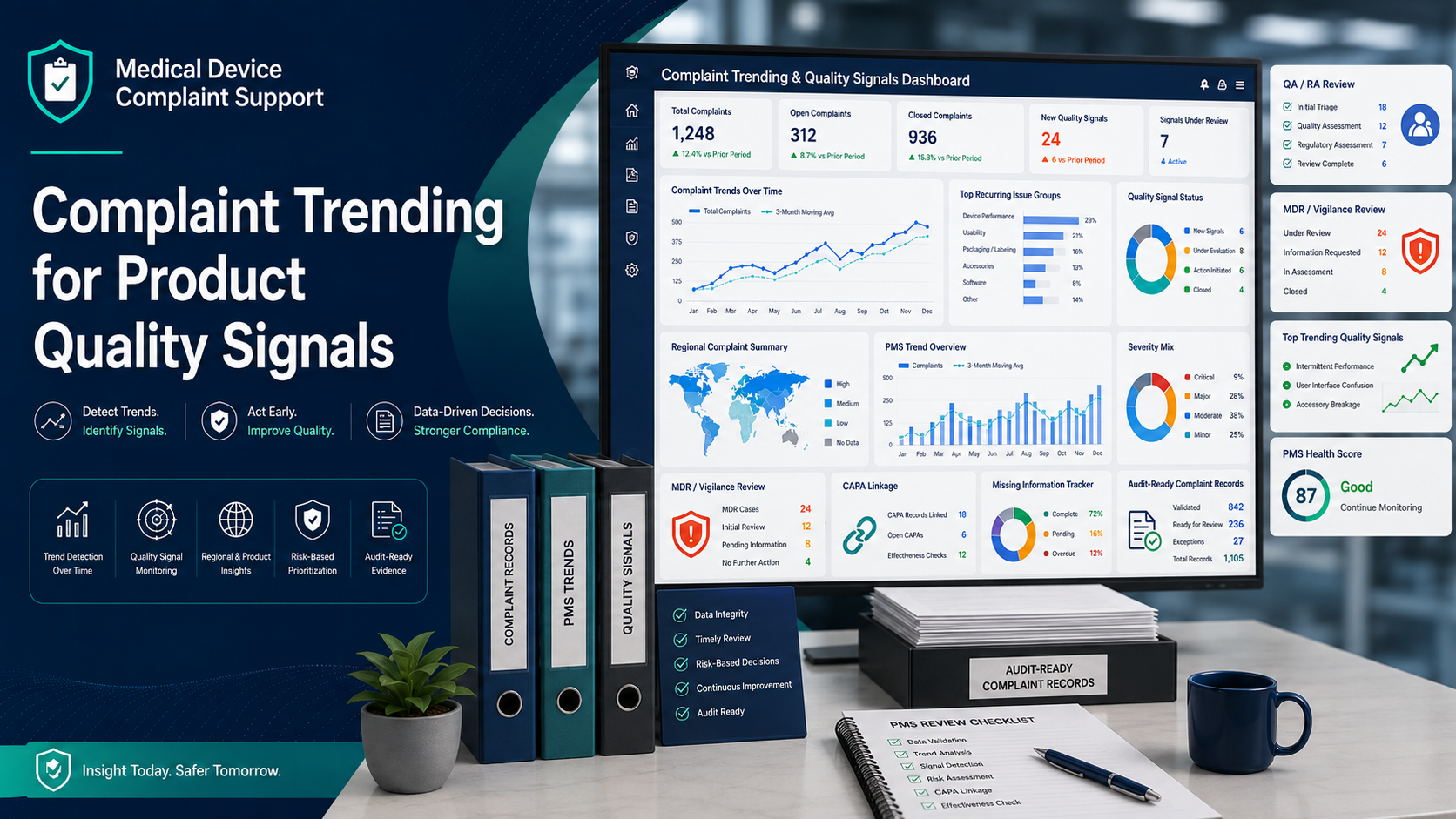
A single complaint may show one customer concern. A group of similar complaints may show a recurring product issue, service pattern, regional trend, documentation weakness, usability concern, or quality signal that needs further review.
Complaint trending is the process of organizing complaint data so teams can review recurring categories, product issue groups, time-based patterns, regional differences, complaint volume, escalation signals, investigation outcomes, PMS inputs, CAPA connections, and management review summaries.
Medical Device Complaint Support provides operational, documentation, workflow, and back-office support for complaint trending and product issue analysis. Our role is to prepare clean data, organized summaries, and review-ready trend inputs while manufacturer-owned decisions remain with authorized internal teams.
Complaint records can be grouped by product family, model, lot, serial number range, software version, failure mode, complaint category, or issue type.
Trend summaries can show whether specific issues appear more often in certain countries, distributors, regions, customer channels, or service routes.
Complaint trends can preserve visibility into cases that may require QA, RA, MDR/vigilance, PMS, CAPA, technical, field service, or management review.
Investigation notes, returned product findings, technical service references, and evidence summaries can be organized to support recurring issue review.
Complaint trend tables can support post-market surveillance reviews by showing product issue frequency, category movement, regional signals, and open documentation gaps.
Trend summaries can help CAPA owners understand related complaint groups, possible systemic issues, supporting evidence, and quality-system follow-up needs.
Complaint trending depends on data quality. If product identifiers are missing, issue categories are inconsistent, event descriptions are unclear, or records are duplicated, trend summaries can become unreliable or difficult to interpret.
Good complaint trending requires consistent terminology, complete complaint fields, clear issue categories, organized attachments, validated dates, product family grouping, regional classification, investigation references, and review-ready summaries.
Operational support can help by cleaning complaint data, grouping related records, preparing trend tables, tracking missing information, standardizing issue labels, and organizing complaint summaries for authorized review.
Important boundary: complaint trending support can organize data and prepare summaries. Final conclusions, risk assessments, CAPA decisions, regulatory interpretations, quality approvals, and product decisions remain with the manufacturer or authorized personnel.
Complaint data collected
Records checked for completeness
Issue categories standardized
Product groups organized
Recurring patterns summarized
PMS/CAPA visibility maintained
Trend tables prepared
Authorized quality review
The exact data fields depend on the manufacturer’s procedures, complaint system, product type, device risk profile, markets served, and internal trend review process. However, many teams benefit from consistent trend-ready complaint fields.
When these details are standardized, complaint trend summaries become more practical for QA, RA, PMS, CAPA, and management review teams.
Complaint trends become difficult to interpret when the same issue is described in many different ways. One region may label an issue as a device malfunction, another may classify it as a usability concern, and another may enter it as a service problem.
Other common problems include duplicate complaints, missing product identifiers, incomplete event descriptions, inconsistent severity fields, missing investigation references, weak attachment organization, and no clear linkage between complaint records and CAPA or PMS review categories.
Unstandardized terminology, missing product fields, unclear event narratives, inconsistent complaint categories, duplicate records, poor regional classification, weak investigation references, and no structured trend summary format.
Structured complaint trending support helps reduce these gaps by preparing cleaner data, better groupings, clearer tables, and more review-ready summaries.
Medical Device Complaint Support can assist with complaint trending and product issue analysis under client-approved procedures, templates, systems, and access controls. Support can be used for active complaint queues, backlog cleanup, PMS summaries, CAPA preparation, recurring issue analysis, and management review inputs.
The objective is to help internal teams work from cleaner complaint data and better organized trend summaries before authorized quality review.
Complaint trend data may include product identifiers, event descriptions, customer information, investigation notes, service records, returned product details, regional complaint summaries, and quality-system information.
Public website inquiries should remain process-focused. Detailed complaint datasets, patient-identifiable information, protected health information, confidential complaint files, proprietary product records, or sensitive quality-system data should only be shared through secure client-approved channels after engagement review.
Medical Device Complaint Support provides operational, documentation, workflow, and back-office support only. This article does not provide legal, regulatory, clinical, or quality-system consulting advice.
Complaint trending is the process of organizing and reviewing complaint data to identify recurring issue categories, product quality signals, regional patterns, investigation themes, PMS inputs, CAPA linkage, and management review information.
Standardization helps teams compare complaint records consistently. Without clean categories, product identifiers, dates, regions, and issue descriptions, trends may be difficult to interpret or may require repeated manual cleanup.
Yes. Complaint trend summaries can help CAPA owners review related complaint groups, recurring issue categories, supporting evidence, and potential quality-system follow-up needs. Final CAPA decisions remain with the manufacturer.
No. We provide operational and documentation support for trend preparation. Final quality conclusions, risk decisions, CAPA decisions, PMS conclusions, and regulatory interpretations remain with the manufacturer or authorized personnel.
Contact Medical Device Complaint Support for complaint data cleanup, recurring issue grouping, product quality signal summaries, and review-ready trend preparation.
Medical Device Complaint Support provides operational, documentation, workflow, and back-office support for complaint handling processes. Final regulatory decisions, MDR submissions, reportability determinations, legal interpretations, quality approvals, PMS conclusions, CAPA decisions, product risk decisions, trend conclusions, and final complaint closure decisions remain the responsibility of the medical device manufacturer or authorized QA/RA personnel.
This article is for general informational purposes only and does not provide legal, regulatory, clinical, or quality-system consulting advice.