Controlled Complaint Intake
Complaint intake should capture essential details such as product information, reporter details, complaint source, event description, dates, region, and available supporting information.

FDA QMSR awareness is important for medical device teams because complaint records are part of a broader quality-system environment. Complaint handling, documentation discipline, escalation visibility, and review-ready records can all support stronger operational control.
This article explains the practical connection between complaint records, QMSR-aware documentation, MDR workflow support, post-market surveillance inputs, CAPA coordination, and manufacturer-owned quality decisions.
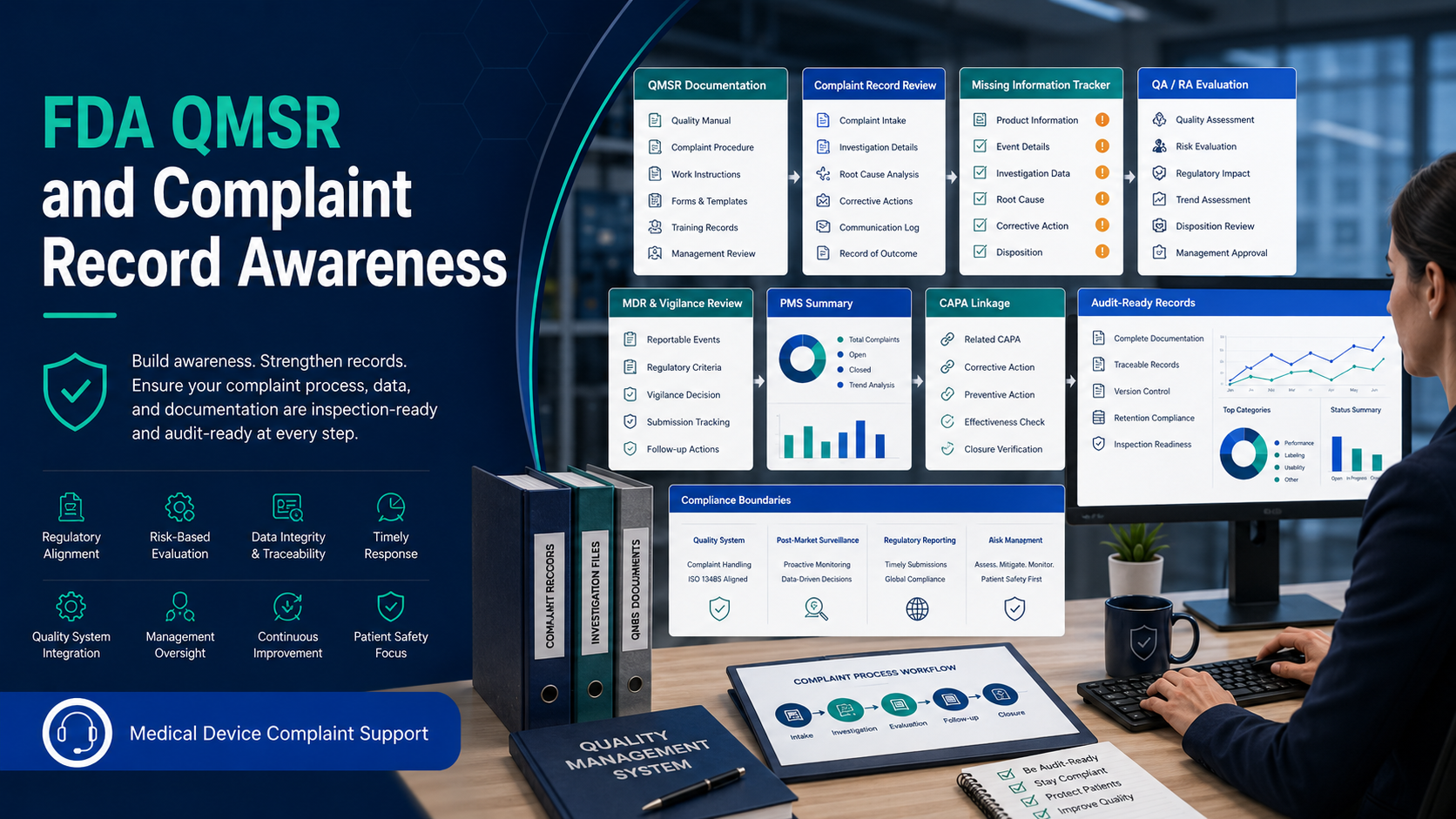
Medical device complaint records are not ordinary customer service notes. They can become quality-system records that support investigation, escalation, regulatory review, post-market surveillance, CAPA evaluation, recurring issue analysis, and audit preparation.
With FDA’s Quality Management System Regulation environment, manufacturers need to maintain controlled quality processes and documentation practices. Complaint handling teams should therefore focus on complete records, clear traceability, consistent categorization, missing information tracking, and manufacturer-approved review pathways.
Medical Device Complaint Support provides operational, documentation, workflow, and back-office support for complaint handling teams. Our work helps organize complaint records and workflow packets while keeping final regulatory and quality decisions with the manufacturer or authorized QA/RA personnel.
Complaint intake should capture essential details such as product information, reporter details, complaint source, event description, dates, region, and available supporting information.
Complaint records should be organized in a repeatable way so authorized reviewers can understand the issue, open items, supporting evidence, and workflow status.
Incomplete complaint records should clearly show pending fields, follow-up needs, missing device details, unclear event descriptions, and attachment gaps.
QA and RA reviewers benefit from complaint packets that summarize known facts, open questions, attached evidence, escalation indicators, and next workflow steps.
Potentially reportable events require careful manufacturer review. Support teams can organize information and workflow packets without making final reportability decisions.
Complaint data can support post-market surveillance, CAPA coordination, recurring issue monitoring, product quality signals, and management review summaries.
A complaint record should make the situation clear. It should help the reviewer understand what product was involved, who reported the issue, what happened, when the concern was received, what information is missing, what attachments are available, and whether additional review or escalation may be needed.
When complaint records are incomplete, teams may spend more time chasing information instead of reviewing the actual issue. Missing device identifiers, unclear event descriptions, weak attachment organization, inconsistent issue categories, and poor follow-up logs can create delays across the complaint lifecycle.
A QMSR-aware documentation mindset helps teams keep complaint information structured, traceable, and ready for authorized review.
Important boundary: documentation support does not replace manufacturer responsibility. Final reportability decisions, MDR submissions, regulatory interpretations, risk evaluations, quality approvals, and complaint closure decisions remain with the manufacturer or authorized QA/RA personnel.
Complaint receipt visibility
Complete intake fields
Traceable communication history
Missing information tracking
Evidence and attachment indexing
Triage and escalation preparation
PMS, CAPA, and trending inputs
Authorized QA/RA review
Many complaint handling teams do not struggle because they lack technical knowledge. They struggle because the operational workload is repetitive, high-volume, and detail-heavy. Complaint records may arrive from multiple regions, distributors, service teams, customer support channels, email inboxes, spreadsheets, and complaint systems.
Common challenges include incomplete intake records, duplicate complaints, weak issue categorization, missing attachments, delayed follow-ups, unclear escalation history, unstructured investigation notes, and backlog pressure.
Structured support can help reduce these operational gaps by preparing cleaner records, better summaries, stronger trackers, and more consistent documentation packages.
Medical Device Complaint Support helps regulated teams with complaint documentation and workflow support under client-approved procedures. The objective is to support accuracy, consistency, traceability, and review readiness.
Complaint intake support, case documentation, missing information tracking, triage preparation, investigation documentation, MDR/vigilance packet preparation, PMS data support, CAPA documentation coordination, complaint trending summaries, backlog cleanup, and multilingual complaint intake support.
Our team can work inside approved complaint systems, eQMS platforms, CRM tools, secure trackers, spreadsheets, or client-defined templates depending on the agreed workflow and access control model.
We do not make final regulatory decisions, quality decisions, legal interpretations, or complaint closure decisions. Those decisions remain with the manufacturer or authorized QA/RA team.
Complaint data may include sensitive product, customer, clinical, or operational details. For that reason, the first public website inquiry should stay process-focused. Manufacturers should avoid sending confidential complaint records, patient-identifiable information, protected health information, proprietary product data, or reportable event details through an unsecured public form.
Initial discussions can focus on complaint volume, backlog status, service interest, system type, workflow challenge, regions involved, and support model. Detailed record exchange should occur only after confidentiality terms, access controls, and secure communication methods are established.
Medical Device Complaint Support provides operational, documentation, workflow, and back-office support only. This article does not provide legal, regulatory, clinical, or quality-system consulting advice.
Complaint documentation remains an important quality-system activity. A QMSR-aware workflow should emphasize structured records, traceability, complete information, and manufacturer-approved review pathways.
No. Outsourced support can help organize documentation and workflow packets, but final regulatory, quality, compliance, and closure decisions remain with the manufacturer or authorized QA/RA personnel.
Yes. Organized complaint records can support post-market surveillance inputs, recurring issue visibility, CAPA coordination, product quality signal review, and management review preparation.
Teams should avoid sending PHI, patient-identifiable information, confidential complaint files, proprietary product details, reportable event records, or sensitive quality-system data through public website forms.
Contact Medical Device Complaint Support for structured complaint documentation, workflow, backlog, PMS, CAPA, and MDR/vigilance packet support.
Medical Device Complaint Support provides operational, documentation, workflow, and back-office support for complaint handling processes. Final regulatory decisions, MDR submissions, reportability determinations, legal interpretations, quality approvals, product risk decisions, and final complaint closure decisions remain the responsibility of the medical device manufacturer or authorized QA/RA personnel.
This article is for general informational purposes only and does not provide legal, regulatory, clinical, or quality-system consulting advice.