Event Fact Organization
Support teams can organize the known event details, complaint source, reporter information, device details, date received, region, and available evidence.
MDR and vigilance workflows depend on clear complaint records, complete event information, structured follow-up tracking, and review-ready documentation packets for authorized QA/RA evaluation.
Operational support can help complaint teams organize event narratives, missing information, attachments, communication logs, and escalation visibility while final reportability decisions remain with the manufacturer.
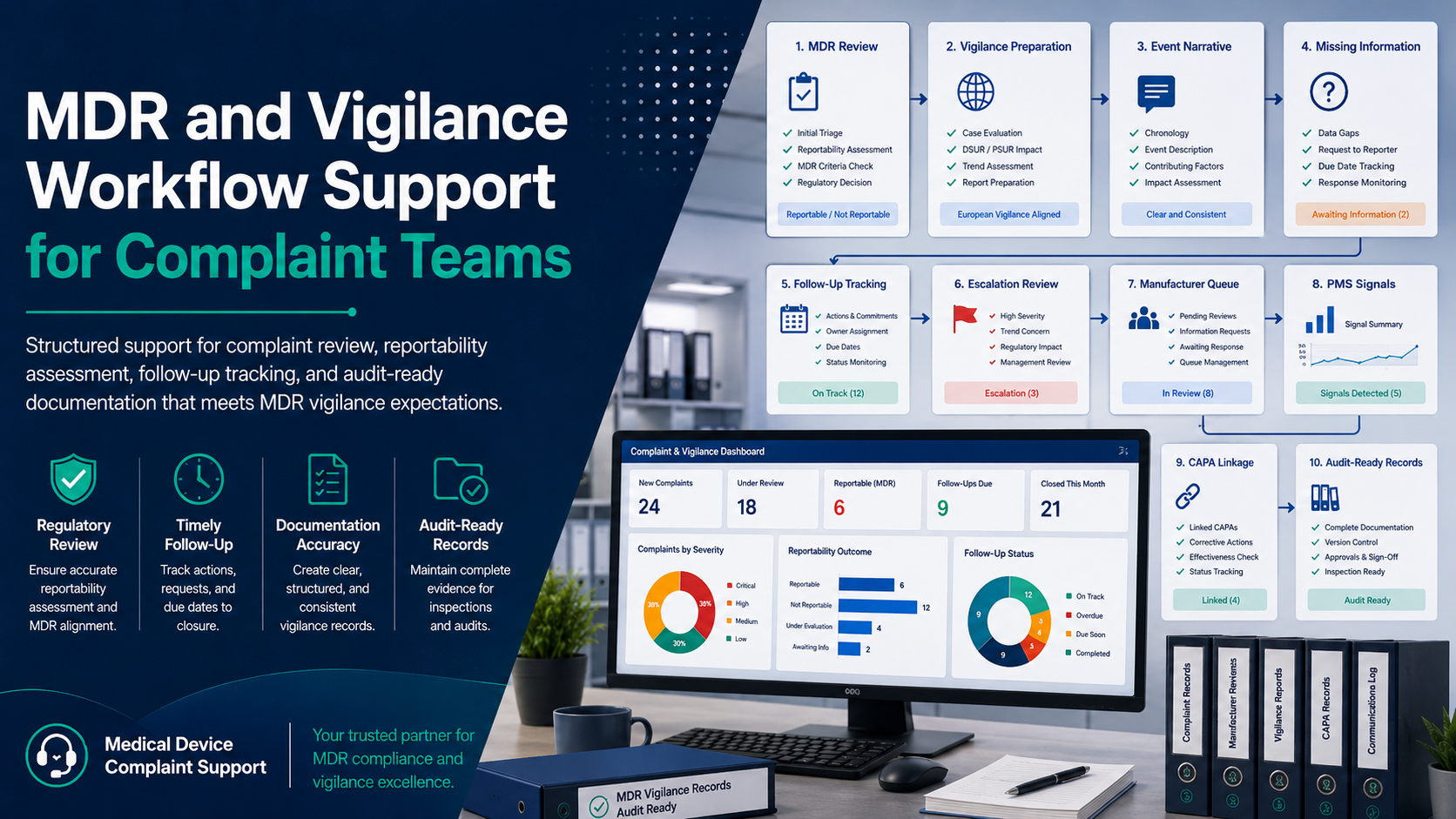
Medical device complaints can contain information that may require further regulatory review. Some records may need MDR evaluation in the United States or vigilance review in other regions. For complaint teams, the challenge is not only identifying possible escalation signals, but also preparing the documentation needed for authorized review.
Complaint records may include event descriptions, reporter details, device identifiers, dates, outcome information, attachments, service records, returned product notes, investigation inputs, and follow-up communications. If this information is incomplete or scattered, MDR or vigilance review can become slower and harder to manage.
Medical Device Complaint Support provides operational, documentation, workflow, and back-office support for MDR and vigilance workflow preparation. We help organize records and review packets, but final reportability decisions, regulatory submissions, and quality decisions remain with the manufacturer or authorized QA/RA personnel.
Support teams can organize the known event details, complaint source, reporter information, device details, date received, region, and available evidence.
Open questions, missing device identifiers, unclear event details, pending attachments, and follow-up needs can be tracked for authorized review teams.
Complaint details can be formatted into clear internal event summaries so QA/RA reviewers can understand what happened without searching across multiple records.
Communication history, outreach attempts, pending responses, additional information requests, and case updates can be documented in a consistent format.
MDR or vigilance review packets can include event facts, attachments, missing information notes, investigation references, communication logs, and escalation indicators.
Complaint data can be organized for PMS inputs, CAPA review, recurring issue monitoring, product issue grouping, and management review summaries.
MDR and vigilance workflows must be handled carefully because they involve manufacturer responsibilities, regulatory timelines, event evaluation, and approved decision-making pathways. Back-office support can help organize information, but it must not replace authorized QA/RA judgment.
A support team can prepare an internal packet, summarize available information, track missing fields, format event narratives, organize attachments, and maintain follow-up visibility. The manufacturer or authorized QA/RA team remains responsible for evaluating the complaint, determining reportability, submitting any required reports, and closing the complaint under approved procedures.
Important boundary: Medical Device Complaint Support does not make final MDR reportability decisions, submit MDR or vigilance reports, provide regulatory interpretation, approve risk decisions, or close complaints. These responsibilities remain with the manufacturer or authorized QA/RA personnel.
Complaint identified for review
Event facts organized
Missing information tracked
Attachments and evidence indexed
Event summary prepared
Follow-up log maintained
Review packet assembled
Authorized QA/RA decision
The exact information needed depends on the manufacturer’s procedures, product type, market, device family, event details, region, and complaint system. However, complaint teams often benefit from a consistent review packet structure.
A complete, organized packet helps internal teams review the complaint more efficiently and understand what information is known, what remains open, and what needs authorized decision-making.
Delays often happen because complaint information is incomplete or scattered across several sources. Event details may be stored in email, CRM notes, call logs, field service reports, complaint systems, returned product records, or regional communication threads.
Common challenges include missing device identifiers, unclear event narratives, incomplete outcome information, delayed reporter follow-up, missing attachments, inconsistent complaint categories, and weak visibility into open questions.
Unclear event descriptions, missing product identifiers, poor attachment tracking, no follow-up log, duplicate case information, delayed escalation, incomplete investigation references, and no structured review packet for QA/RA teams.
Structured MDR and vigilance workflow support helps reduce these operational gaps by creating organized records, clearer summaries, and better follow-up visibility.
Medical Device Complaint Support can assist with MDR and vigilance workflow preparation under client-approved procedures, templates, systems, and escalation rules. Support can be applied to active complaint queues, backlog cleanup, multilingual complaint sources, regional complaint centers, and investigation documentation workflows.
The objective is to help authorized QA/RA reviewers receive clearer, better organized, and more review-ready complaint records.
MDR and vigilance workflow records may include sensitive product, customer, user, patient, clinical, event, or quality-system information. Public website inquiries should stay process-focused and should not include confidential complaint files, patient-identifiable information, protected health information, reportable event details, or proprietary product data.
Detailed data exchange should happen only through secure client-approved communication channels, defined confidentiality terms, controlled access, and agreed documentation workflows.
Medical Device Complaint Support provides operational, documentation, workflow, and back-office support only. This article does not provide legal, regulatory, clinical, or quality-system consulting advice.
MDR workflow support is operational assistance with organizing complaint information, event summaries, missing information, attachments, follow-up logs, and review packets for authorized manufacturer evaluation.
No. We support documentation and workflow preparation only. Final reportability decisions, MDR submissions, vigilance submissions, risk decisions, quality approvals, and complaint closure decisions remain with the manufacturer or authorized QA/RA personnel.
Yes. Support can include follow-up logs, pending information tracking, communication history updates, missing field review, and review packet organization under client-approved workflows.
Yes. Organized complaint records can support post-market surveillance inputs, CAPA coordination, recurring issue analysis, product quality signal visibility, and management review preparation.
Contact Medical Device Complaint Support for structured MDR/vigilance workflow preparation, missing information tracking, event narrative support, and review-ready documentation assistance.
Medical Device Complaint Support provides operational, documentation, workflow, and back-office support for complaint handling processes. Final regulatory decisions, MDR submissions, reportability determinations, legal interpretations, quality approvals, product risk decisions, and final complaint closure decisions remain the responsibility of the medical device manufacturer or authorized QA/RA personnel.
This article is for general informational purposes only and does not provide legal, regulatory, clinical, or quality-system consulting advice.