Issue Categorization
Triage helps organize complaints by issue type, product concern, service concern, packaging issue, labeling concern, malfunction signal, usability issue, or documentation gap.

Complaint triage helps regulated teams understand where a complaint should go next. It supports issue categorization, escalation visibility, investigation preparation, MDR/vigilance review readiness, PMS inputs, and CAPA coordination.
Strong triage does not replace manufacturer decision-making. It prepares cleaner information so authorized QA, RA, complaint handling, PMS, and CAPA teams can review cases more efficiently.
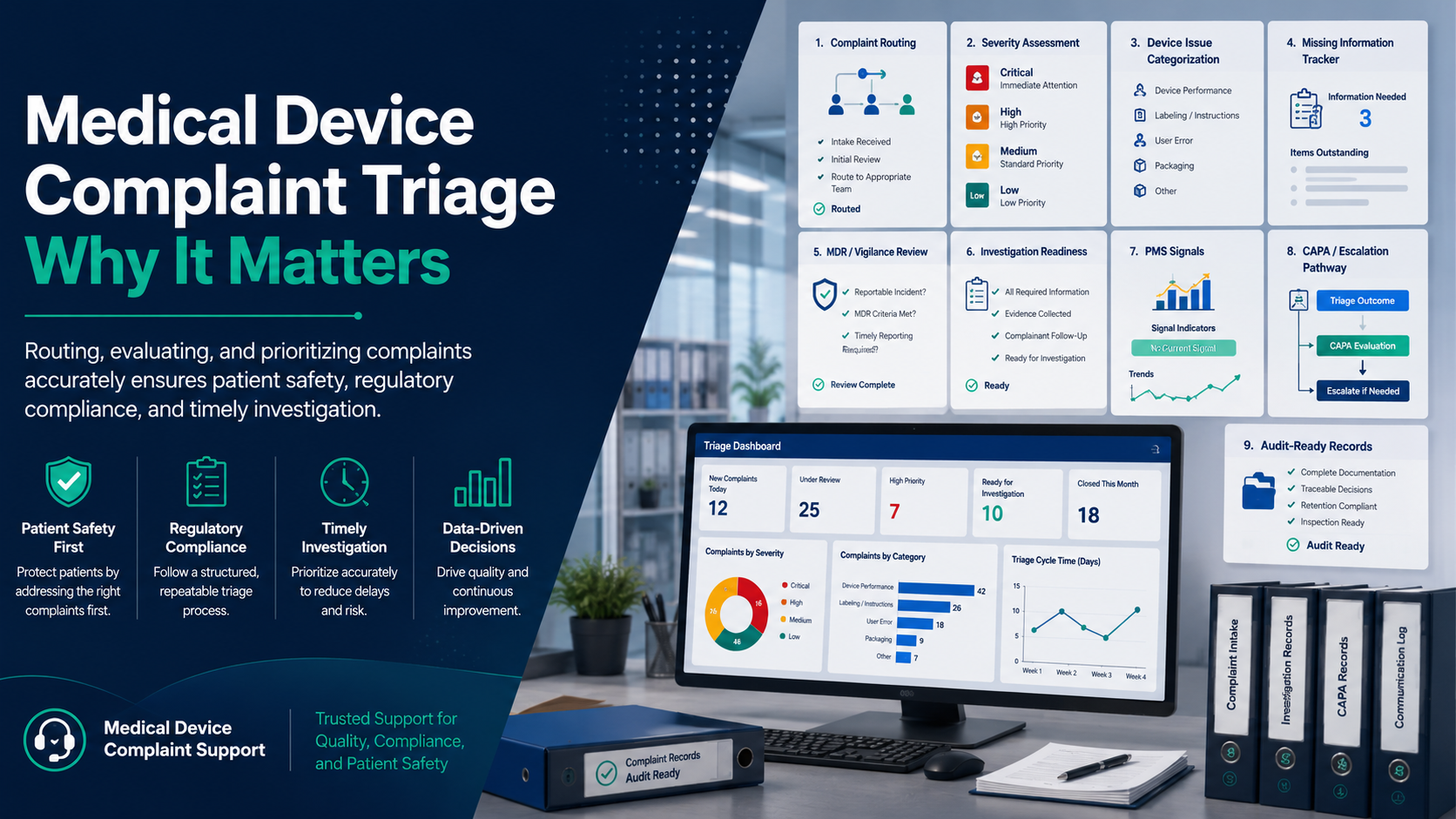
A complaint may arrive with incomplete, unclear, or scattered information. Complaint triage helps organize that information so the right team can understand the issue, determine the next pathway, and identify whether additional review, investigation, escalation, or follow-up is needed.
For medical device teams, triage can influence how a complaint moves through the quality system. A complaint may need routine documentation, technical review, investigation, MDR or vigilance review, PMS input, CAPA assessment, product issue trending, or urgent escalation to authorized personnel.
Medical Device Complaint Support provides operational and documentation support for triage preparation. Our role is to organize case information, highlight missing fields, prepare categorized summaries, and improve visibility for authorized reviewers.
Triage helps organize complaints by issue type, product concern, service concern, packaging issue, labeling concern, malfunction signal, usability issue, or documentation gap.
Complaint records can be prepared so reviewers can quickly see whether the case may need QA, RA, PMS, CAPA, technical, field service, or management attention.
Triage preparation can highlight missing product identifiers, unclear event descriptions, missing attachments, incomplete reporter details, or pending follow-up needs.
Well-triaged complaint records help investigation teams see available evidence, returned product status, service notes, technical details, and open documentation gaps.
Some complaints may require MDR or vigilance review. Support teams can organize packets and escalation indicators while final reportability decisions remain with the manufacturer.
Consistent triage categories help complaint data become more useful for post-market surveillance, CAPA coordination, recurring issue analysis, and management review summaries.
Triage preparation is not the same as making final regulatory or quality decisions. It is the operational work of structuring complaint details so authorized personnel can review the case with less friction.
A triage-ready file should show the complaint source, product information, event description, affected region, available attachments, missing information, preliminary issue category, escalation indicators, and any workflow notes that help reviewers understand what still needs attention.
When the record is organized before review, QA and RA teams can spend more time evaluating the issue and less time searching for basic details.
Important boundary: triage support can prepare information and highlight workflow signals, but final triage decisions, MDR decisions, risk decisions, quality approvals, investigation decisions, and complaint closure remain with the manufacturer or authorized QA/RA personnel.
Complaint received
Case details reviewed
Issue category prepared
Missing information tracked
Escalation indicators noted
Investigation readiness checked
MDR/vigilance packet prepared if needed
Authorized QA/RA review
The information needed for triage depends on the manufacturer’s procedures, device type, market, risk profile, product family, complaint system, and workflow rules. However, many teams benefit from a consistent triage preparation checklist.
A clean triage package helps the reviewer understand what is known, what is missing, and where the case may need to go next.
When triage preparation is weak, complaint teams may see delayed escalations, inconsistent issue categories, unclear investigation needs, missing evidence, duplicate work, and poor visibility into open items.
These gaps can create pressure for QA, RA, PMS, CAPA, technical support, and field service teams. Instead of reviewing structured records, teams may spend time searching emails, checking attachments, clarifying device identifiers, or reconstructing complaint narratives.
Incomplete intake data, unclear event descriptions, missing device identifiers, inconsistent severity indicators, poor attachment tracking, delayed follow-up, unclear escalation routing, and backlog of unreviewed complaint records.
Structured triage support helps create clearer routing, stronger documentation visibility, and more consistent complaint workflow preparation.
Medical Device Complaint Support can assist complaint teams by preparing triage-ready records under client-approved procedures, templates, and workflow rules. The work can be adapted for ongoing complaint queues, backlog cleanup, multilingual intake, regional complaint centers, and high-volume documentation environments.
The objective is to help authorized reviewers receive cleaner complaint files and make workflow decisions with better visibility.
Complaint triage may involve product information, customer details, clinical context, returned product notes, regional complaint data, service records, and potential event information. These details should be handled through approved systems, access controls, confidentiality requirements, and secure communication methods.
Public website inquiries should remain process-focused. Confidential complaint records, patient-identifiable information, protected health information, proprietary product data, and reportable event details should not be sent through unsecured forms.
Medical Device Complaint Support provides operational, documentation, workflow, and back-office support only. This article does not provide legal, regulatory, clinical, or quality-system consulting advice.
Complaint triage is the process of organizing and reviewing complaint information to determine the appropriate workflow path, such as documentation, investigation, escalation, MDR/vigilance review, PMS input, CAPA coordination, or authorized QA/RA review.
No. Triage support can prepare information, organize packets, and highlight workflow indicators. Final reportability decisions, MDR submissions, risk decisions, and quality decisions remain with the manufacturer or authorized QA/RA personnel.
Yes. Triage support can help organize backlog records, identify missing information, prepare issue categories, summarize complaint details, and route records for authorized review under client-approved workflows.
Consistent issue categorization helps teams identify recurring product signals, support PMS and CAPA workflows, reduce duplicate review effort, and improve visibility across complaint operations.
Contact Medical Device Complaint Support for structured complaint triage preparation, missing information tracking, and review-ready workflow support.
Medical Device Complaint Support provides operational, documentation, workflow, and back-office support for complaint handling processes. Final regulatory decisions, MDR submissions, reportability determinations, legal interpretations, quality approvals, product risk decisions, and final complaint closure decisions remain the responsibility of the medical device manufacturer or authorized QA/RA personnel.
This article is for general informational purposes only and does not provide legal, regulatory, clinical, or quality-system consulting advice.