Product Issue Grouping
Complaint records can be grouped by product family, model, lot, issue type, complaint category, failure mode, region, device version, or customer segment.

Complaint data can be one of the most useful operational inputs for post-market surveillance. When complaint records are complete, categorized, and trend-ready, they can help teams identify product issue patterns, recurring signals, regional concerns, and potential quality-system follow-up needs.
Post-market surveillance depends on organized information. Complaint documentation support can help PMS teams receive cleaner inputs without shifting manufacturer-owned regulatory or quality decisions.
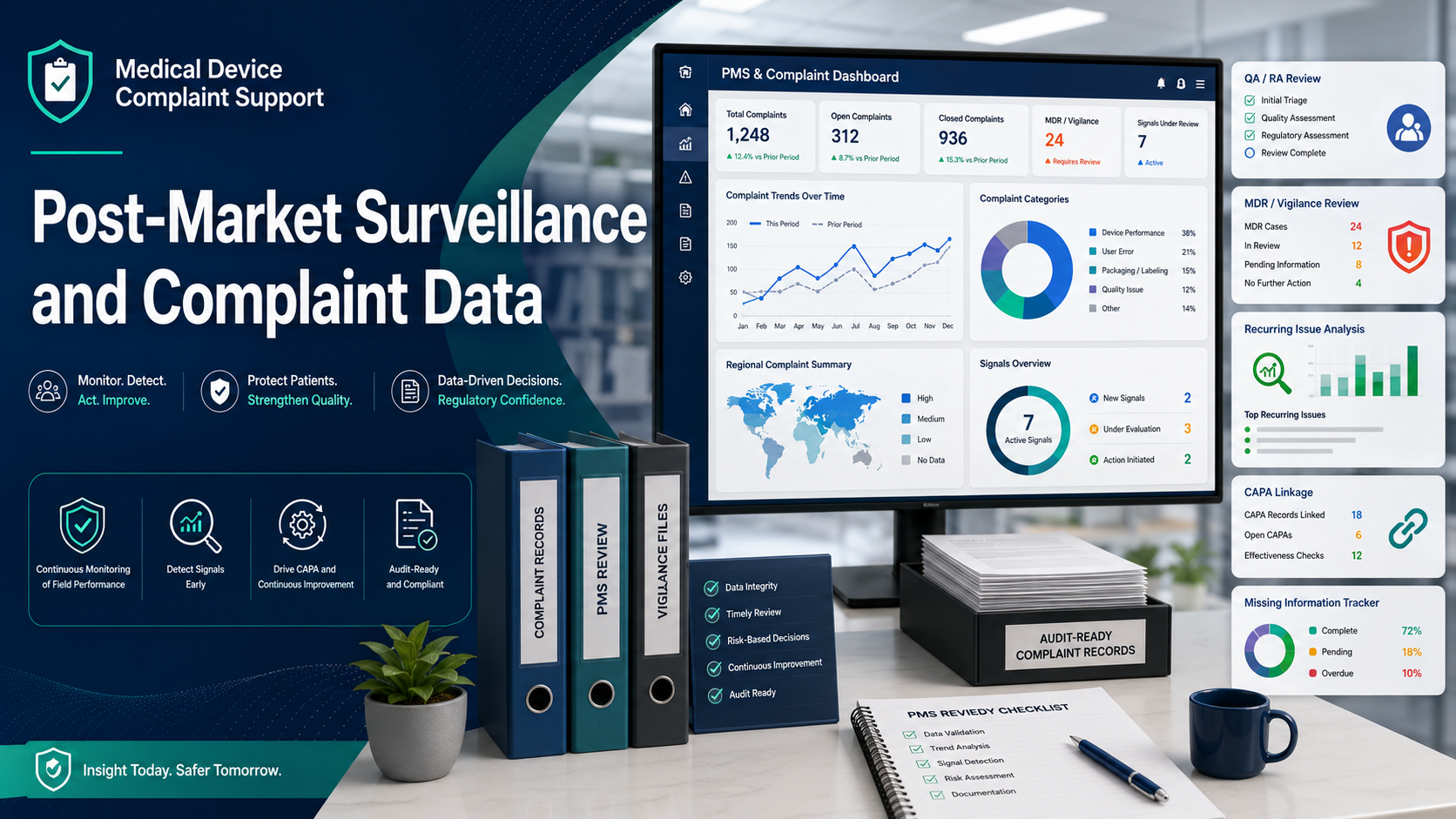
Post-market surveillance is not only about collecting information after a device reaches the market. It is also about organizing that information so manufacturers can review product performance, user experience, safety signals, quality issues, and recurring patterns over time.
Complaint data is often one of the most direct sources of post-market product feedback. It may reveal repeated product concerns, device malfunctions, labeling questions, packaging issues, service-related failures, customer usage challenges, regional complaint patterns, or quality-system trends.
However, complaint data becomes useful only when records are clean, consistent, categorized, traceable, and ready for review. Incomplete or inconsistent complaint files can weaken PMS visibility and make trend review more difficult.
Complaint records can be grouped by product family, model, lot, issue type, complaint category, failure mode, region, device version, or customer segment.
Standardized complaint categories help teams see whether similar issues are occurring repeatedly across markets, product lines, regions, or time periods.
Complaint data can be summarized by country, distributor, region, customer channel, or service route to support PMS and management review visibility.
Complaint files may include information that requires authorized MDR or vigilance review. PMS data support can preserve visibility into escalation indicators without making reportability decisions.
Complaint summaries can help CAPA owners understand related complaints, recurring issue groups, supporting evidence, and potential quality-system follow-up needs.
Trend-ready complaint data can support summaries for quality meetings, PMS reviews, CAPA discussions, complaint backlog status, and operational performance visibility.
Complaint data can only support reliable PMS review if it is entered, cleaned, categorized, and maintained consistently. Poor data quality can create misleading trends, duplicate counts, weak product issue grouping, incomplete escalation visibility, and unclear root-cause signals.
Common complaint data quality issues include missing product identifiers, inconsistent issue categories, vague event descriptions, incomplete dates, duplicate records, missing attachments, unclear regional source information, and weak linkage between complaint files and investigation notes.
Operational support can help by standardizing complaint fields, reviewing missing information, organizing attachments, preparing issue categories, and maintaining structured summaries for authorized PMS review.
Important boundary: PMS data support can organize complaint information and prepare summaries, but final PMS conclusions, risk assessments, regulatory interpretations, CAPA decisions, and quality approvals remain with the manufacturer or authorized personnel.
Complaint records collected
Data fields checked
Missing information tracked
Issue categories standardized
Product groups organized
Trend summaries prepared
CAPA/MDR visibility maintained
Authorized PMS review
The exact data points depend on the manufacturer’s approved procedures, device type, product family, risk profile, regulatory market, and complaint system. Still, many PMS teams benefit from consistent complaint data preparation.
When these details are standardized, PMS teams can review complaint information more efficiently and identify meaningful patterns with less manual cleanup.
Many complaint datasets are difficult to use because information is captured inconsistently across regions, systems, products, and complaint sources. One team may classify an issue as a malfunction, another may describe it as a user issue, and another may leave the category blank.
Other common problems include duplicate records, inconsistent terminology, incomplete device identifiers, unclear event descriptions, missing investigation references, poor attachment indexing, and weak linkage between complaint records and CAPA or PMS review categories.
Unstandardized issue categories, missing product identifiers, duplicate complaint entries, poor regional coding, incomplete follow-up notes, weak attachment organization, and no clear link between complaint data, CAPA review, and trend summaries.
Structured complaint data support helps reduce these gaps and makes PMS review more practical for internal quality and regulatory teams.
Medical Device Complaint Support can assist with complaint data organization for post-market surveillance workflows under client-approved procedures, templates, systems, and access controls. The support model can be used for ongoing complaint queues, backlog cleanup, recurring PMS data preparation, regional summaries, and product issue grouping.
The objective is to help PMS, QA, RA, CAPA, and complaint handling teams work from cleaner complaint data and better organized summaries.
Complaint records used for PMS may include customer details, device identifiers, event narratives, product performance information, investigation notes, clinical context, service data, and other sensitive operational information.
Public website inquiries should remain process-focused. Detailed complaint datasets, patient-identifiable information, protected health information, proprietary product details, reportable event records, or confidential quality-system files should only be shared through secure client-approved channels after engagement review.
Medical Device Complaint Support provides operational, documentation, workflow, and back-office support only. This article does not provide legal, regulatory, clinical, or quality-system consulting advice.
Complaint data can support PMS by showing recurring product issues, complaint categories, regional patterns, product family concerns, MDR or vigilance review visibility, CAPA linkage, and trend information for authorized review teams.
Yes. Organized complaint data can help CAPA owners identify related complaints, recurring issue groups, supporting evidence, trend patterns, and possible quality-system follow-up areas. Final CAPA decisions remain with the manufacturer.
Yes. Complaint data may include information that requires authorized MDR or vigilance review. Support teams can help organize records and preserve review visibility, while final reportability decisions remain with the manufacturer or authorized QA/RA personnel.
No. We provide operational, documentation, workflow, and data organization support. Final PMS conclusions, risk assessments, regulatory interpretations, CAPA decisions, and quality approvals remain with the manufacturer or authorized personnel.
Contact Medical Device Complaint Support for complaint data cleanup, issue grouping, PMS summaries, CAPA linkage support, and review-ready trend preparation.
Medical Device Complaint Support provides operational, documentation, workflow, and back-office support for complaint handling processes. Final regulatory decisions, MDR submissions, reportability determinations, legal interpretations, quality approvals, PMS conclusions, product risk decisions, CAPA decisions, and final complaint closure decisions remain the responsibility of the medical device manufacturer or authorized QA/RA personnel.
This article is for general informational purposes only and does not provide legal, regulatory, clinical, or quality-system consulting advice.