Complaint Receipt
Capturing incoming complaint information from approved channels such as email, phone, CRM, distributor reports, service logs, or complaint systems.
Medical device complaint handling is the structured process of receiving, documenting, reviewing, evaluating, investigating, escalating, trending, and closing complaints related to medical devices under manufacturer-approved procedures.
For regulated device teams, complaint handling is not only a customer response activity. It is a quality-system workflow that can affect QA review, RA review, MDR or vigilance evaluation, post-market surveillance, CAPA coordination, and audit readiness.
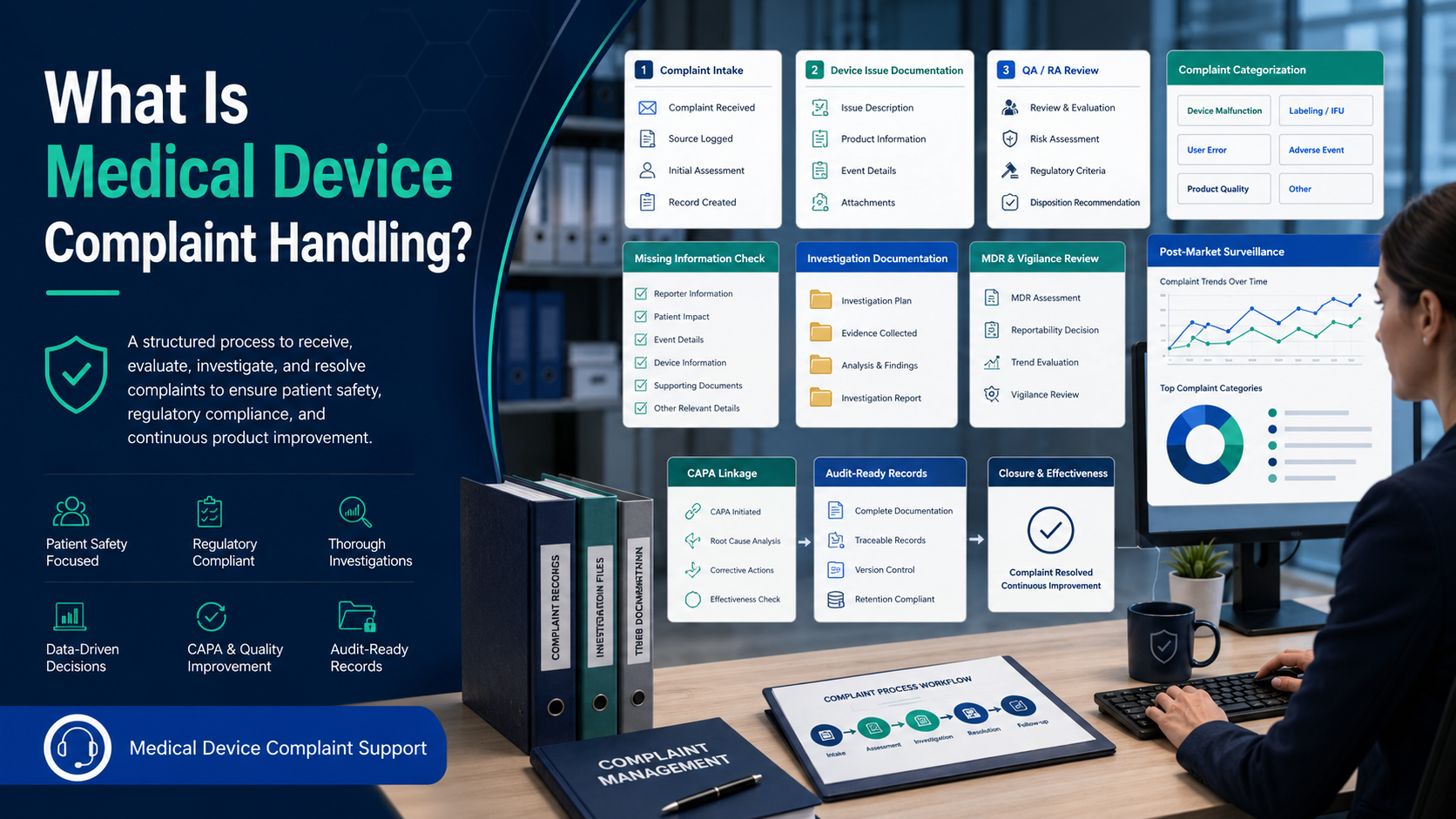
A medical device complaint may start from a customer call, distributor message, hospital user report, field service note, returned product record, email, regional support ticket, or internal technical observation. Once a possible complaint is identified, the information should be captured and organized in a consistent way.
The purpose of complaint handling is to make sure device-related concerns are received, documented, reviewed, evaluated, investigated when appropriate, routed correctly, and available for quality and regulatory review. This process helps manufacturers understand product issues, customer experiences, potential safety signals, recurring patterns, and documentation gaps.
Medical Device Complaint Support provides operational, documentation, workflow, and back-office support for complaint handling teams. Our role is to help organize records, prepare case information, track missing details, support workflow visibility, and prepare review-ready documentation under client-approved procedures.
Capturing incoming complaint information from approved channels such as email, phone, CRM, distributor reports, service logs, or complaint systems.
Creating or updating a complaint record with reporter details, product information, device identifiers, event description, region, dates, and available attachments.
Organizing complaint facts so authorized teams can understand the issue, assess completeness, and decide the next workflow path.
Preparing categorized information, issue type, escalation indicators, missing details, and routing visibility for client QA/RA review.
Supporting evidence organization, attachment indexing, technical note formatting, returned product information, and investigation record preparation.
Preparing workflow packets, event narrative inputs, follow-up logs, and missing information trackers for authorized MDR or vigilance review.
Complaint handling matters because complaint records can provide evidence of product performance, possible device failures, use-related issues, packaging concerns, service problems, labeling concerns, customer experience gaps, and repeated product quality signals.
If complaint documentation is incomplete or inconsistent, downstream review becomes more difficult. QA teams may need to chase missing device details. RA teams may need clearer event narratives. PMS teams may need better issue categorization. CAPA teams may need cleaner links between related complaints. Management review may need trend-ready summaries.
Strong complaint handling helps teams reduce confusion, improve traceability, support timely review, and create better visibility across complaint operations.
Important boundary: support teams can organize complaint information and prepare documentation, but final regulatory decisions, MDR submissions, risk evaluations, quality approvals, and complaint closure decisions remain with the manufacturer or authorized QA/RA personnel.
Complaint Received
Case Created
Information Reviewed
Missing Details Tracked
Triage Prepared
Investigation Supported
PMS/CAPA Inputs Organized
QA/RA Review & Closure
The exact data fields depend on the manufacturer’s approved procedures, product type, system configuration, regional rules, and complaint workflow. However, many complaint records require a consistent set of operational details.
The goal is not just to fill fields. The goal is to create a record that authorized reviewers can understand, evaluate, and close under approved procedures.
Medical device complaint teams often face high volume, incomplete information, regional intake differences, multilingual complaint sources, documentation backlog, investigation file cleanup, PMS data preparation, and repetitive record maintenance tasks.
Outsourced back-office support can help by keeping complaint records organized, tracking missing fields, preparing case summaries, updating communication logs, indexing attachments, preparing workflow packets, and supporting trend-ready data organization.
This allows internal QA, RA, PMS, CAPA, and complaint handling teams to focus more time on review, evaluation, decision-making, and procedure-based closure.
Complaint intake, case documentation, triage preparation, investigation documentation, MDR/vigilance workflow packet preparation, PMS data organization, CAPA coordination, complaint trending, backlog cleanup, and multilingual intake support.
No. Customer service may receive the first communication, but medical device complaint handling is a controlled quality workflow that may involve documentation, review, investigation, escalation, regulatory assessment, PMS input, CAPA coordination, and closure under approved procedures.
Final complaint decisions remain with the manufacturer or authorized QA/RA personnel. Outsourced support can assist with documentation, workflow preparation, tracking, and case organization, but not final regulatory or quality decisions.
Yes. Support can include packet preparation, event narrative organization, follow-up tracking, and missing information review for authorized MDR or vigilance evaluation. Final reportability decisions and submissions remain with the manufacturer.
Yes. Backlog support can include complaint record cleanup, missing field review, attachment indexing, communication log updates, duplicate review support, and review-ready case preparation under client-approved workflows.
Contact Medical Device Complaint Support to discuss complaint handling workflow assistance for regulated medical device teams.
Medical Device Complaint Support provides operational, documentation, workflow, and back-office support for complaint handling processes. Final regulatory decisions, MDR submissions, reportability determinations, legal interpretations, quality approvals, product risk decisions, and final complaint closure decisions remain the responsibility of the medical device manufacturer or authorized QA/RA personnel.
This article is for general informational purposes only and does not provide legal, regulatory, clinical, or quality-system consulting advice.